Thursday, 31 December 2020

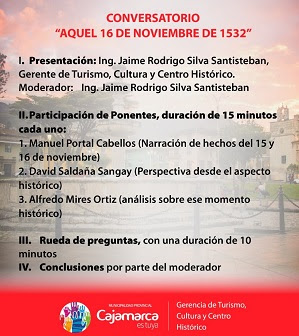
"That 16th of November of 1532"

Our brother Alfredo participated in the Cycle of Conversations ‘Open Classrooms - Heading to the Bicentennial’, organized by the Cajamarcan Municipality.

On this occasion, Alfredo reflected on the fateful date of 16th November 1532. What happened that day should be taken into account not only by the people of Cajamarca, but by the whole country and the world. “We cannot imagine what a huge wound may have been left in the survivors after the massacre; a population that was accustomed and that had among its paradigms the celebration of life, the celebration of affection, the celebration of solidarity, the minga.

He also indicated that after 588 years, “this tragedy has not passed, it is not something that has been left behind; we are referring to something that in many ways continues to happen.”

“For this reason, in the Rural Library Network of Cajamarca, every 16th November, for more than 30 years, we commemorate 'The Day of Here We Are', because despite the massacres and despite everything that happened and continues to happen, we continue standing, we continue walking. We have never perceived ourselves as defeated but as community members who remain on the path that our grandparents taught us. Not to celebrate the conquest, not to commemorate death, but at least to pay tribute to those who fell, those innocents who fell by the hands of this, not encounter, but, in fact, this massacre that nobody expected.”


From whom do i learn?

A few weeks ago I was asked what training I received during my time as a student teacher, the question included my training in virtual environments.

Considering that I studied to be a teacher in the 1980s, it is to be imagined that the most advanced technology that I had at my fingertips was the typewriter that my neighbor lent me when a teacher required us to present our work transcribed in said apparatus.

The first time I was confronted with the use of a computer was around 1997 when, the first day I arrived as Alfredo's assistant, he asked me to put addresses on some letters that later had to be printed. I remember that I told him “I have never operated a computer”, he replied: “I am going out, so pay attention”, and he told me what steps I should follow to achieve that first great feat. Sure enough, when he came back, the letters were ready and the document had three or four backups. Thus, Alfredo taught me something every day. I also remember one afternoon when I couldn't open the files, so Rita rushed to my aid and told me that by typing "win" the computer would show everything I needed. Over the years, I have also learned as my children have had patience to teach me. During all these years, there has been someone who taught me the tricks of these devices and helped me discover the things that can be done with them; like Karina, a constant and patient teacher.

And there are many more things that I learnt and am still learning with my family of the network: be careful when presenting documents, which must always be impeccable and understandable; take care of the organization of an activity anticipating the situations that could arise; read more and better for ourselves and for others; write taking care of the smallest details of writing, but, above all, of ideas.

And so it is that you learn according to the teacher. In the network, I have several: Alfredo, with his love, patience, insistence and perseverance. I am also be a better teacher because of him as he doesn't lose heart in his constant attempts to make us true teachers. Rita, always supportive and looking for ways to help children with projected abilities to have a dignified, constant and forward-looking life. Karina, taking care of the house and the resources of the Network so that they last longer. Rumi, Mara, Zelma, young companions, full of life and enthusiasm. Nathalia, studious and organized, doing her best so that the Network is also up to date with the documentation. And what to say about my fellow volunteers: the teacher José Isabel, always ready to support me by telling stories to my school children (this year it could not be), and all the others, each with their personal touch of simplicity and wisdom.

It is incredible how many teachers I have in the network, how much I learn from them and how much more I still have to learn.

Thank you, Alfredo, for bringing me here.

Lola Paredes Saldaña


Tuesday, 22 December 2020

David, present

On the 20th November, 7 years ago, David Osoro Gonzales - our brother- returned to the bosom of the earth, to the apus, to infinity. But he is still alive in our memories, in our daily work, our hearts.

David volunteered for the Network in 2013. He began with the arduous task of converting all our library work to the virtual format that we continue to use at this time.

A few days before his departure he wrote this text. Whoever visits the Network, can appreciate it in our Main Room.

“The Rural Libraries project is not simply a great idea, which I never doubted: it is also the driving force behind an exciting concept based on solidarity, respect and the enhancement of a culture that the more I know about it, the more it amazes me.

Life is not just getting where you want at any cost; it is, above all, about growing and helping others to do so too.

We are not alone…".

Thanks, David, for being with us. We are not alone.


Rain!


A few weeks ago we were already very worried: the crops began to suffer, some were even lost. Some friends told us that there was no longer grass or water for the animals; for consumption just a little bit. We were sad: without water we are nothing.

Today we are celebrating: we celebrate together with the dear earth the arrival of the rain - how can we not celebrate if the rain strengthens life?

It will be possible to continue breeding, our fields will turn green and the colors will ripen; the animals will have fresh grass and we will soon enjoy the rich flavors of our mother earth.

Welcome downpour: with you our hopes are always reborn.


Shared shrines

In September we had a virtual meeting with our esteemed teacher Alfredo Mires. The event was organized by the Social Sciences Specialty of the "Víctor Andrés Belaunde" School of Pedagogical Higher Education in Jaén, with 34 students. The objective was to read and reflect on the central contributions of his book "Primordial Sanctuaries - Cave Art in Cajamarca" from the author's perspective.

Maestro Alfredo spoke about the importance of the investigative experience, he emphasized the sacredness of the diversity of sites and footprints carved in stone, paintings in the mountains and utensils created by our ancestors. He spoke about their perceptions of the world, their relationship with nature, their journeys and struggles for survival. A different perspective to approaching rock art.

Likewise, he questioned the dominant stereotype of our imaginings: that the population of this historical stage was backward and only simple "hunter gatherers". In this regard, he argued a historical periodization called the "Age of Rearing", to explain the evolution of rock art in Cajamarca, which helped us to rediscover that our ancestors were the discoverers of food seeds in the seminal stage, which means that they were breeders of life, a valuable statement that helps us re-signify our historical memory and strengthen our pride and identity with our roots.

The students asked various questions of all kinds related to his inspiration for writing the book and motivations for the research, the activities and needs of the ancestors that underlie the paintings, why it is said that art continues with us and why the Education system does not incorporate this knowledge, among other questions. They were reason to clarify, deepen explanations and perspectives.

We are happy and recognized for the lessons learned and we look forward to having a next meeting.

Sara Moreno Alberca

Professor of the Higher Pedagogical Institute


Monday, 23 November 2020

Towards a prehistory of Cajamarca

- Cycle of Open Classroom Conversations Towards the Bicentennial

- "Towards a prehistory of Cajamarca"

- Friday October 30

- 5:00 p.m. to 6:30 p.m.

- Transmission: Fanpage of the MPC and via YouTube - Canal Escuela Taller San Antonio, Cajamarca

- Link: https://bit.ly/2Bpw6SF


Libraries in network

Yesterday I had the opportunity to witness the virtual conversation between Laura Acero from BibloRed, Colombia, and Alfredo Mires from the Red de Libraries Rurales de Cajamarca:

https://www.youtube.com/watch?v=emb6JoqOYbQ

I am a follower of Rural Libraries, awaiting their news and –in these times of pandemic– I have been able to enjoy many webinars, virtual presentations and similar conversations through different channels and platforms.

It is always enriching, encouraging and hopeful to listen to what Alfredo shares with such kindness and gratitude, but last night's conversation was really beautiful.

Laura, so kind and affectionate, inspired a lot of tenderness and respect for the work of Rural Libraries, and managed to convey her admiration for the work of the Network to the public. And Alfredo presented, in a very short time, a sum and an extension of everything that Rural Libraries does: from its conception to the details of the exchange of books, from the encouragement and effort that a Coordinator inspires to the need to join forces to protect this planet. It was, really, great.

Thanks again to the Rural Libraries Network and BibloRed, Colombia, for such a beautiful sunset. Congratulations and my great respect.

A follower of the Wanderings