Thursday, 13 October 2016

Dictionaries on the move


We are very pleased to have visited the Rural Libraries project in Peru during the summer, and to be witness to how the dictionaries that we managed to obtain in the Christmas campaign are being distributed to the librarians.

Rachel Hardy, Simon Wheatley and I were very fortunate to be able to be in the countryside in order to meet with the coordinators and librarians who make it possible for the indigenous campesino families in the Andes have access to books.

We spent one night at the house of Don Jacinto Aguilar Neyra, who is 68 and has been a volunteer librarian for 33 years. He is currently responsible for six libraries and was very excited to deliver the new dictionaries since many people make frequent applications for these. It was a warm, moonlit evening and we joined in a traditional ceremony with his family, in honor of the mountains, the earth and the dead.

Previously, Don Jacinto told us of what was lived through in the communities during the time of violence in the 1980s, when the country was rocked by the violence of an internal war. He was responsible for 40 libraries in 4 sectors. Many of them had to close because the librarians were affected and persecuted by the warring factions. In many places the rural librarians had to bury the books in their fields and Jacinto had to live in the mountains, for safety, for a long time. Slowly, Don Jacinto managed to reawaken the libraries and today two  new coordinators will help with tasks in the future.

Many thanks to all who continue to support this inspiring community with their efforts to develop literacy and their promotion of the Andean culture.

Helen Heery
(On behalf of Sarah's Rural Library Fund)


Rain and growth


In early September, the person responsible for the Community Program and two volunteers traveled to Masintranca, in the province of Chota, to visit children there with projectable capabilities and their families from the communities of Huayrasitana and Numbral.

On the road the sky covered over and, upon arrival, everyone greeted us with great joy. "You have brought the rain" said the villagers happily, and we shared with them this satisfaction of the first downpours that the land was crying out for.

In the communities the children and Parent Groups of our coordinators Donaida Guevara and Sergio Diaz had gathered. Both coordinators are long-term integrants of the Community Program and their work is truly admirable.

For this visit we had been asked to review three issues with the Parent Groups: our proposal for child protection, how to raise awareness among students and teachers for better school inclusion and how to eat well with products from our own farms.

While parents, coordinators and the person responsible for the Program did a review of these issues, our volunteers - Samay, Erica, Carla and Mara played with the children and taught them to weave bracelets. It was an extraordinary experience.

The work with the parents was also wonderful, not only for their interest in continuing to share and learn, but also because - thanks to the ongoing work of Sergio and Dona which is like the rain: gentle and constant, you can feel the growth of the plants of knowledge in each of the parents.


Uncovering colonialism in Jaén


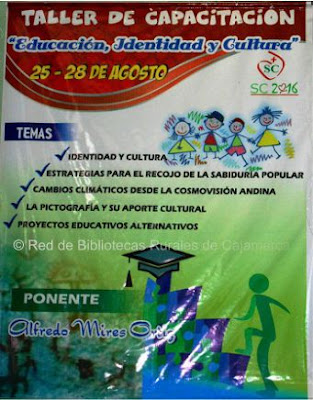
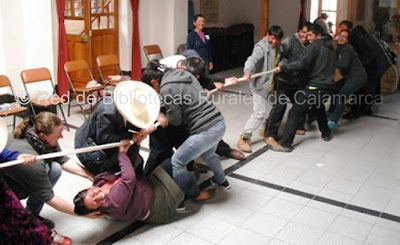
Despite being far, Jaen is with us. In late August, Alfredo Mires - member and Advisor our Network -, gave three days of training to more than 40 teachers from the Cajamarcan province of Jaen.

Alfredo explored deeply the theme of colonialism and education and how we, as teachers, act as transmitters of an imposed dogma, with or without our knowledge or consent. The discussion evidenced manipulation methods used by those who wish to control us.

Recognizing the problem, then we moved to the solutions.

What are the cultural passwords that can be used to protect our rich culture from attack? To continue living and growing as a dynamic community in the direction we decide, not to follow a prescribed route to destruction and assimilation...

Part of the conversation focused on the valuing of our own culture, reinforcing it, rescuing what has been lost and restoring the current through which the wisdom flows: the connection between our elders and our youth. A key element, highlighted Alfredo, is respect: respect for others, respect for ourselves and respect our Mother Earth.

Participants were also very interested in learning about the Rural Libraries and our 45 years of establishing and supporting a movement that cultivates (ploughs, ​​fertilizes) our essence, which enriches our culture through the sharing of books, especially books about the extraordinary wisdom of our people, past and present.

This rich shared experience was made possible thanks to the invitation and organization of Elizabeth Olano and the Communications Team at the Sacred Heart Secondary School in Jaén. We are very grateful for their tremendous dedication.


So much to learn, so much to do


In August, the Community Program had their final training of this year. The meeting was also attended by some fathers, mothers and children of projectable capabilities that we are attending to.

To share this time and space with the families means a lot to us because it gives us the opportunity to know each other better and learn together.

At the beginning of this meeting the coordinators reaffirmed their commitment to continue supporting the children, families and communities, and then expressed in a very deep and loving way their responsibility and effectiveness during reflections, testimonies and dynamics with which we worked with the parents.

Then there was much to share and learn. We dealt with different and very varied topics such as nutrition, therapy techniques, relaxation, reflexology, an exchange of good practices to encourage the cooperation of the family members in the therapy, the benefits of relaxing the mind through the colouring of mandalas and the importance of reading.

On Saturday night there was an intense cultural rescue on the Rights of the Child in the Andean conception and on Sunday we visited the Alternative Campesino School of Pomabamba to learn about ecological construction, environmental protection, harvesting and recycling of water.

Now, on returning to our communities, we are left with the challenge of sharing the lessons with our families and Parent Groups. There is much to do, and we will do it heartily.


Tuesday, 13 September 2016

Our blog in French is back on its feet

We are pleased to announce the revival of our blog in French and, at the same time, welcome Julia Steiner into the family of volunteers of our Network of Rural Libraries of Cajamarca. Julia has already been working hard on the translations and now the blog in French is on its feet once again.

We heartily thank Maryse Tétreault who, as a volunteer, started the blog and worked with dedication on the previous translations.

With Julia we debated the new nomination and in the end we decided on La voie des bibliothèques rurales de Cajamarca”. Julia explained to us that "it is like ‘the way of the libraries of Cajamarca’. It is a play between ‘the road’ and ‘the spiritual path’, and with the sound (because the word "voice" in French is pronounced "voix" and has the same sound)”.

The resurrected La Voie des Bibliothèques Rurales de Cajamarca will continue at the following address: http://redbibliotecasfrances.blogspot.pe/


We would be very grateful if you could share it with your francophone friends.

Meeting up


We recently held the Encounter II - Encyclopedia Campesina Project 2016.

This event not only involves coming together to rescue knowledge and traditions – to later transform them into bibliographic material – but it is also a way to meet up and get to know each other closely, with the pretext of work.

It’s because we come from different and distant communities, and we all arrive keen to share our knowledge, our way of seeing the world and our aspirations for a more pleasant life based on what we are and what we want to continue being, as our brother Alfredo always tells us, who is our guide in this work.

These spaces allow us to learn from and with each other, and know that everything we bring to share will affirm our unity, as one community; when everything comes together like forming a book, a great lesson from the world and for the world.

Monday, 12 September 2016

Wonderings in Cajabamba


This August, with our English friends from Sarah’s Rural Library Fund, we visited a number of our libraries in the provinces of Cajamarca, San Marcos and Cajabamba.

We were with José Isabel Ayay Valdez, in the Quechua zone of Cilimpampa, sharing enthusiasm, wisdom and humour.

Later with Pascual Sánchez of Chuco, veteran coordinator of our libraries in his zone. He told us how his love of reading was inspired by his father and how he spent many long nights by the smoky gas lamp reading borrowed books. He laments the irony of how just when reading is made easier by the arrival of electricity, the book is abandoned for the TV. For this reason, he explains, the work of BR is important now more than ever; to continue our enrichment and to keep alive our ability to travel to new worlds each time we open a book cover.

We then visited the community of Pingo, in Cajabamba, which houses its library in the local primary school. The children, with their parents and teachers, shared with us illuminating theatrical presentations of stories that they collected from the elders of their community. We then had the honour to participate in a minga de trilla: the traditional art of separating the wheat stalks from the grains, celebrating with chicha (fermented drink made from maize).

The journey didn’t end there: we spent the night in the house of our brother Jacinto Aguilar Neyra and listened by moonlight to his memories as library coordinator during the bloody years when the country was rocked with the violence of the civil war. The generosity of books and the courage of the humble made it possible to keep going.


And we were the community of Corralpampa, whose library is also located in their primary school. We participated in an extraordinary sharing of stories, where the children gathered round us to relay what their elders had passed on to them. The magic of the Andean oral tradition, the passing of ancient wisdom from generation to generation, was felt by all as we saw and heard the words of our ancestors emerge from the mouths of the young.