Sunday, 26 June 2016

Of healers and plants


In late May, the Community Program of our Rural Libraries Network invited coordinators and healing teachers to the Second Training Session of this year.

We spent intense and beautiful moments as we shared knowledge on medicinal plants and preparation of remedies. Together we made and packaged hundreds of natural medicines for our work with children with disabilities in the countryside. We also experimented how to prepare natural soap free of toxic ingredients and we learned about speech therapy, motor skills, school awareness and inclusion and adapting to chairs, crutches and canes for children with projectable capabilities.

Coordinators also shared with the group some issues they had learned about through reading and self-study at home and demonstrated therapy practices that they carry out in their communities.

In the evaluation of the event the spirit of everyone to keep learning and participating was evident. The meetings are an important point of reference for us to renew our work and strengthen our spirit.


Monday, 20 June 2016

Oxford with us


A box overloaded with fantasy and worlds to venture into came to us from Oxford University Press, encouraged by our enthusiastic friends in England.

Books of excellent material and thematic quality, in Spanish and -above all- to encourage children with reading.

At a time when the twisted irons have more headlines than the lucid spirits, gestures such as this – the sharing of books, these fruit bearing seeds, are to be joyfully celebrated, admired and appreciated.


Guinea Pigs and Foxes


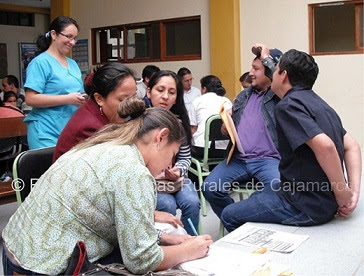
As part of a training session organized by the Community Programme for the Accompaniment of People with Projectable Capacities (Programa Comunitario Para el Acompañamiento de Personas con Capacidades Proyectables) –carried out in the Sócota hospital-, health professionals, teachers and parents participated in a dynamic called "Guinea pigs and foxes".  Alfredo Mires, Network Coordinator, led the activity helped by Rita Mocker, Programme Manager, and the coordinators of the Programme in the area.

During the discussion which followed the dynamic, the mechanisms of privatization -increasingly more severe- by small groups at the expense of the majority, were highlighted. Alfredo also focused on the tendency we sometimes have to concentrate on the small problems, everyday disputes, while forgetting that there are enormous problems - the destruction of the planet, the manipulation of the system, the inertia of the authorities, the pollution of our water by extractive projects or with rubbish, the loss of respect in our society and the numbing of the minds of our children. Also… "We are now confronted with illnesses that we never knew before; our streets are full of pharmacies ... When did we become a sick society?"


Alfredo commended the health workers, teachers and parents for the excellent work they do to help the progress of children with difficulties and to ease their suffering. “The more fortunate we are, the more we have to learn, and the more responsibility we have to serve those who haven’t been as fortunate and who are in need of assistance. When we have a child with difficulties in the classroom, it is us and the other children who are the real "beneficiaries": in this way we can also learn to be more caring, more generous, fairer and more humane".

Opening eyes


One of the objectives of the work of the Community Programme is to reduce the gap between people with disabilities and those who have not had contact with people with a similar limitation.

It has been several years since the Peruvian State began promoting school inclusion. We are also seeing in all public institutions notices to give preference to people with disabilities in queues. There are also laws that state that these people can have a pension. But has anything really changed in our vision, in our minds, in our hearts?

"... And if you were us?" is the question that the Community Programme asks in awareness workshops and training sessions in rural areas, with teachers, health personnel and local authorities. And the surprises that we encounter are sometimes big.

In the month of May, the coordinators of the Community Programme in San Luis de Lucma and Sócota, in the province of Cutervo, organized two of these workshops.

We were able hear the difficulties with inclusion that teachers faced in their classrooms, we heard about the low budgets of the offices responsible for the problems of disability, and of the tedious administrative and bureaucratic maneuvers in public institutions ...

To listen to and to debate these difficulties is the first step. But we also manage to raise awareness amongst participants through dynamic tasks, practice and role play and like this, in an enjoyable manner, we all open our eyes and our hearts a little more. And we end up learning something that will help us make an effort with or to shake the hand of a child with a disability.

Thanks to the sponsors, organizers and participants of these events.


Connections

In mid-May I had the opportunity to travel to Sócota to visit children with projectable capabilities, together with the coordinators of this area.
I saw progress in the skills of many children; I enjoyed their enthusiasm, their smiles, their astonishing courage and their immense love. I also marveled at the growth of the families of these children and the extraordinary solidarity that the Parent Groups deploy...
And I also experienced firsthand the effort that our coordinators invest in this voluntary work. To visit these children twice a month, sometimes even every week- and see, at the same time, the difficult life situation of each of them; then apply the physical force, the mind, the will and energy to help this child, this family, this community, to improve and to be always on good ground, is really admirable.
A few days ago, Alfredo told me the Community Program has a good team. I want to ratify this: we have – or are- a fantastic team. We are this thanks to the fact that we are strict with each other, because we know that working with children we cannot postpone things or fail.

You, Coordinators and Volunteers of the Network, are extraordinary. And I thank from the bottom of my heart all who generously contribute to this struggle. And I continue to invite others, perhaps undecided, to join us on this path. Maybe like this, all together, we can manage to make this world a place worth walking.
Rita Mocker

Aníbal advancing

My name is José Aníbal Segura Tantaleán and I´m from the district of San Juan, in the province of Cutervo. I’m six years with our Rural Libraries. Reading is something that enriches our knowledge and enables us to know much more. It also helps us with writing or communicating with others. For me, it has really helped me guide my children. It has helped me in the community and with participation in assemblies or in different meetings.

In my area we have set ourselves the challenge of improving the conditions of reading; we want to reorganize the libraries with more dynamic people. Sometimes they have libraries in the schools, but they are closed. We want to encourage them to open. There is no shortage of difficulties, but in some places they appreciate these efforts very well. We have to continue coming.

Thursday, 2 June 2016

In La Ramada

We travelled to La Ramada to visit César Burga, rural coordinator of his Bibliotecas Rurales, to greet and converse with those who frequent his library.

The rocky, at times muddy, road opened on one side to an abyss which extended for over half a kilometer. On our arrival we passed almost immediately to the small hamlet of Corralcucho where doña Rosa, César’s mother and doña Elidia, her daughter, presented us with delicious tamales – made fresh with the corn from their field.

As we rested observing the idyllic scene in which they live, we were amused by the bravery of a small chicken who insisted on bothering a chicken of bigger stature. For his audacity he was left practically featherless but he was not to be deterred. He showed us that attitude is half the battle.

That night the meeting in César’s home started as any good meeting does–  chewing coca leaves, cultivated en small farms and free of toxins, a careful practice that is becoming sadly less common as pressure from the big pharmaceuticals to flood crops with pesticides is taking effect. The attraction of fast, easy production at times overpowers the knowledge that natural remedies and organic production, which has persevered for many centuries, is the only secure method of ensuring the survival of the art of agriculture and our food sovereignty in the face of attempted domination by the system.

This discussion leads us to the similar theme of tobacco, and how the cigarettes that now pervade the market are full of poisons and purposefully contain addictive properties. The locals recall a time when the production and preparation of wild tobacco was a common practice in their community – without toxins and full of the natural beneficial properties of the plant. The animated discussion left us with a desire to learn more, and the glint in Alfredo’s eye told us that another book had begun to write itself.

In response to an invitation from the farmers, Alfredo explained more about the concept of Bibliotecas Rurales – i.e. the constant movement of books as opposed to their repose in stagnant spaces, and the importance of the book in rural areas. He spoke of how we are losing our connection with our ancestors and with our community: “Time betrays the memory”, he told us, and he recalled an appropriate saying: “He who doesn’t remember his past, is destined to trip up on the same rock ”.

We have so much to learn from our ancestors – they created the seeds that we now grow. How can we rebuild the bridge and reconnect with our roots? We have two sources to help us”, Alfredo explains: “We have the word of our elders - but what if we can’t remember everything they say? Then that is why we have our books. Using the book as a tool we can have written the memories, the knowledge, and the wisdom”.

“However, we are not indulging in nostalgia,” Alfredo clarifies: “The books that collect the knowledge of our elders aren’t books to make us remember how things were, but how things should be”.

The ball of coca sweetened as if to say that it too was in agreement. 


Lynda Sullivan